




HV Lithium Battery
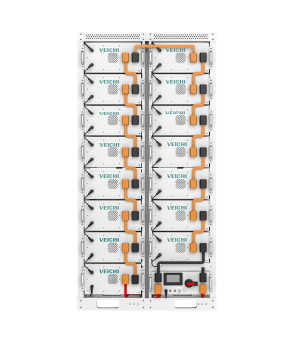
VEICHI designs and builds its high-voltage energy storage batteries in-house, combining automotive-grade LiFePO4 cells, a self-developed multi-level BMS and a stackable modular chassis on a single platform. The flagship VCHB-241K-314 starts from one 16.076 kWh module (51.2 V / 314 Ah) and scales by stacking modules in series: 3 to 15 modules takes the string from DC 153.6 V / 48.23 kWh all the way to DC 768 V / 241.15 kWh, and up to 15 such clusters can then be paralleled for roughly 3.6 MWh on one site. A heavy-duty 1000 V / 250 A main controller plus a 0.5C continuous charge and discharge rate let a fully built cluster move about 120 kW through a 200 A string, while the intelligent BMS handles active cell balancing, accurate SOC and SOH tracking, and millisecond-level protection against over-voltage, over-current and temperature extremes. Native CANBUS, Modbus RTU and TCP/IP give plug-and-play access to an EMS or third-party platform for remote digital O and M, and the integrated fire suppression module detects and extinguishes a cell event within five seconds. The result is a rack-mounted, IP20 battery built to pair with three-phase high-voltage hybrid inverters and PCS in commercial and industrial plants.
More About HV Lithium Battery
What Is a High Voltage Lithium Battery?
A high voltage (HV) lithium battery is an energy storage battery whose DC system voltage runs into the hundreds of volts - typically somewhere between 150 V and 1500 V - rather than the 40 to 60 V band used by low voltage (LV) packs. It gets there by wiring modules in series: every extra module raises the string voltage, while the amp-hour rating stays exactly the same.
HV lithium batteries are the standard choice for:
- Commercial and industrial peak shaving and demand-charge management
- Three-phase hybrid systems and hybrid plants built around a high-voltage PCS
- Factory, campus and micro-grid backup where the required run time is measured in hours
- Large self-consumption PV sites where 48 V cabling would be impractical or uneconomic
If your project sits below roughly 30 kWh or runs on a single-phase inverter, the LV lithium battery range is usually the better fit.
What's the Difference Between an HV Lithium Battery and an LV Lithium Battery?
An HV battery stacks its modules in series, so system voltage rises while amp-hours stay fixed. An LV battery keeps every pack at 51.2 V and adds packs in parallel, so capacity rises while voltage stays fixed. Current, cable size, efficiency, safety class and installer qualifications all follow from that single structural difference.
1. Wiring: series vs parallel
Adding capacity to a VEICHI LV system means bolting on another 51.2 V pack in parallel - the busbar voltage never moves. Adding capacity to the HV system means adding modules inside the string, which raises voltage, or adding whole clusters in parallel, which does not. This is why HV configurations are quoted as "N modules in series" while LV configurations are quoted as "N packs in parallel".
2. Voltage, current and cable size
The practical consequence is current. Delivering the same power, a higher voltage draws proportionally less of it:
- A 241 kWh LV bank at 51.2 V would need roughly 2344 A to deliver 120 kW - far beyond what copper terminations can carry economically.
- The same 241 kWh as a VEICHI HV string at 768 V delivers 120 kW at about 156 A, comfortably inside its 200 A continuous rating.
- Even at a modest 10 kW the gap is about 195 A on LV versus about 13 A on a 768 V HV string.
Lower current means thinner cables, smaller DC protection, less resistive heating and a smaller voltage drop across long runs - the main reason HV dominates once a site gets past roughly 30 kW of load.
3. Power ceiling and system scale
An LV bank is normally limited by its pack BMS to 100 A or 200 A, which at 51.2 V caps a single bank at roughly 5 to 10 kW. The HV VCHB-241K-314 is specified at 0.5C with a 200 A maximum, which puts one full cluster around 120 kW. It then scales further: 15 modules per cluster and up to 15 clusters in parallel give a ceiling near 3.6 MWh, comfortably into C and I energy storage territory.
4. Safety class and installation
48 to 51.2 V falls inside SELV, safety extra-low voltage, so LV packs can be installed by a general electrician and are available in IP65 outdoor enclosures. A 768 V DC string is a different regime: it needs DC isolation, arc-fault protection, clearances, labelling and technicians qualified for high-voltage DC work. That is why the VCHB series is specified IP20 and designed for an indoor cabinet or electrical room rather than an exposed wall.
How to Choose the Right HV Lithium Battery?
Choosing the right HV lithium battery comes down to four things in order: what your inverter accepts, how many modules that takes, how much energy your load profile needs, and how much power it has to deliver at once.
1. Start from the inverter or PCS, not the battery
An HV battery is useless if its string voltage does not sit inside the inverter's permitted battery window. Read the inverter datasheet first, note the minimum and maximum DC battery voltage, then pick the module count whose working range fits inside it. VEICHI three-phase hybrid inverters are designed around these high-voltage strings.
2. Count modules, not just kWh
On an HV system the module count sets the voltage, so it is a design input rather than a nice-to-have:
3. Size energy from the load profile
Work out what the battery actually has to do. For peak shaving, take the load you want to shave in kW, multiply by the hours per day you need to cover, then add margin for depth of discharge and long-term degradation. For backup, list the critical loads, their total kW and the required autonomy hours. Then pick the smallest module count that clears both numbers - remember that adding a module adds energy and voltage together.
4. Size power from the C-rate
Capacity alone can disappoint. A 241 kWh cluster at 0.5C delivers around 120 kW. If your peak shaving target is higher, or you want a shorter and harder discharge window, add clusters in parallel - paralleling adds both power and energy and leaves the string voltage untouched.
5. Check communications and EMS integration
Confirm the battery speaks the protocols your site needs. VEICHI HV batteries support CANBUS, Modbus RTU and TCP/IP for plug-and-play connection to EMS and third-party platforms, which is what makes remote monitoring, scheduling and diagnostics possible across a fleet of sites.
6. Plan the room before you order
IP20 means an indoor cabinet or a dedicated electrical room. Budget for floor loading, service clearance in front of the rack, ventilation or air conditioning, a DC isolator, arc-flash signage, and a technician qualified for high-voltage DC work. Good ventilation also protects cycle life, because LiFePO4 ages fastest when it runs hot.
7. Get the warranty terms in writing
Compare like for like: years of cover, guaranteed retained capacity at the end of those years, and the test conditions behind the stated cycle count - temperature, charge rate and depth of discharge. VEICHI rates the VCHB-241K-314 at over 8000 cycles with a 10-year design life; ask any supplier to state theirs under the same conditions.
Frequently Asked Questions About HV Lithium Batteries
Is an HV lithium battery better than an LV lithium battery?
Neither is better in absolute terms - they suit different systems. HV wins on current, cabling cost and efficiency above roughly 30 kW of load or 100 kWh of storage. LV wins below that, on single-phase inverters, on retrofits, outdoors thanks to IP65 models, and wherever a general electrician rather than a high-voltage specialist can do the work.
Can I mix HV and LV lithium batteries in the same system?
No. Never connect them to the same DC bus or to the same inverter battery port. Choose one architecture and build the whole bank on it.
How many modules can I put in series, and how many clusters in parallel?
The VCHB-241K-314 supports 3 to 15 modules in series per cluster, from 153.6 V to 768 V, and up to 15 clusters in parallel, giving roughly 3.6 MWh. Your inverter's DC voltage window may narrow that range in practice.
Which inverters work with VEICHI HV lithium batteries?
Any three-phase high-voltage hybrid inverter or PCS whose battery input window covers the string's working voltage and which speaks a compatible protocol. VEICHI HV batteries support CANBUS, Modbus RTU and TCP/IP and pair natively with VEICHI three-phase hybrid inverters. Always confirm the exact combination with your supplier before commissioning.
Can the VCHB-241K-314 be installed outdoors?
Not as supplied. It is rated IP20 and intended for an indoor cabinet or plant room. For exposed or semi-exposed locations you need an outdoor-rated enclosure, or an IP65 LV lithium battery instead.
What maintenance does an HV lithium battery need?
Very little compared with lead-acid: no watering, no equalisation charging. Keep the room ventilated and inside the specified temperature band, check terminal torque periodically, keep firmware current, and review SOC and SOH trends through the EMS so a weak module is caught before it drags the string down.
How long will it last?
Real-world life depends most on operating temperature and depth of discharge, so compare vendors using the same test conditions rather than headline numbers alone. VEICHI rates this platform at over 8000 cycles with a 10-year design life.

 Leave a Message