




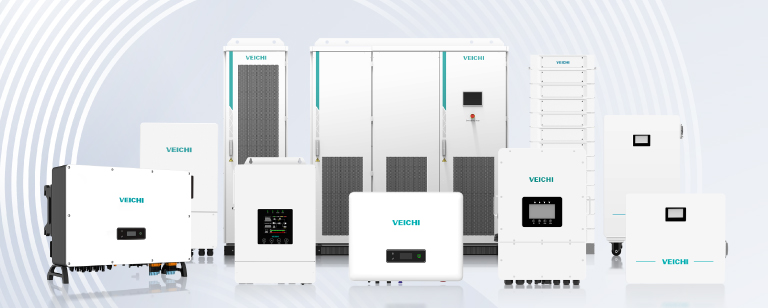
Micro Grid Hybrid Inverter
VEICHI micro grid hybrid inverters hold a site's voltage and frequency, dispatch PV, battery, generator and grid as one system, and transfer between grid-connected and islanded operation without dropping the load. Two series cover the range: VPS01 at 200 kW to 1000 kW across five models, and VPS20 at 300 kW to 1000 kW, which puts PCS, MPPT, DC-DC, STS and EMS in one cabinet.
Both operate at 400 V three-phase, carry 100% unbalanced load, ride through high and low voltage faults, and black-start a site from battery alone. PV input reaches 900 V DC with 120 kW per MPPT channel and up to 12 channels. The DC window is 630 V to 900 V on VPS01 and 450 V to 950 V on VPS20, matching VEICHI HV lithium batteries. Compare ratings, MPPT counts and DC windows on the micro grid inverter models page.
More About Micro Grid Hybrid Inverter
What Is a Micro Grid Hybrid Inverter?
A micro grid hybrid inverter is the control centre of a local power system that can run connected to the utility grid, run islanded from it, or move between the two without stopping the load. It does three jobs in one cabinet: it converts DC from PV and from the battery into AC for the site, it converts AC back to DC to charge the battery, and it decides in real time where each kilowatt-hour should come from.
The difference from a standard hybrid inverter is scale and authority. A residential hybrid inverter manages one house and switches to backup when the grid fails. A micro grid inverter manages a whole site, holds the voltage and frequency for that site while it is islanded, synchronises before reconnecting, and coordinates PV, battery, generator and grid as one system. VEICHI builds this class of machine in the 200 kW to 1000 kW band with both VPS01 and VPS20 series.
How a Micro Grid Inverter Differs From a Standard Hybrid or Off-Grid Inverter
- Standard hybrid inverter – Single-site, typically 3 kW to 30 kW. Backup switching is measured in tens of milliseconds and is acceptable for a home. Battery voltage is usually 48 V or a modest high-voltage string.
- Off-grid inverter – Never connects to the utility. It is the only voltage and frequency reference on the site, so it must be sized for the worst-case load and paired with enough generation and storage to carry the site alone. See off-grid inverters.
- Micro grid hybrid inverter – Does both of the above and moves between them. It forms the grid when islanded, follows the grid when connected, and transfers without dropping the load. It also dispatches several sources at once instead of one.
In practice the deciding question is scope: if the installation has one meter and one backup panel, a hybrid inverter is enough. If it has a transformer, several feeders, a generator, or a contractual requirement to stay running through an outage, that is a micro grid.
What the Inverter Has to Handle on a Real Site
- Unbalanced load – Industrial and commercial sites rarely load the three phases equally. VEICHI micro grid inverters carry 100% three-phase unbalanced load, so a heavily loaded single phase does not force the whole machine to derate.
- Grid faults – High and low voltage ride-through (HVRT/LVRT) keeps the inverter connected and supporting the grid through a dip or a swell, instead of tripping out and making the disturbance worse.
- Starting from nothing – Black start lets the inverter energise the site from battery alone after a total shutdown, with no external grid reference to synchronise to.
- Battery voltage window – The battery must sit inside the inverter's DC window. VPS01-GE0A accepts 630 V to 900 V; VPS20 accepts a wider 450 V to 950 V. Both are Li-Ion, and both sit in the range covered by VEICHI HV lithium batteries.
- PV headroom – Both series accept up to 900 V DC at the PV input with an MPPT working range of 250 V to 850 V, and up to 120 kW per MPPT channel. VPS01-GE0A offers 2 to 12 MPPT channels depending on rating; VPS20 offers up to 12 in a single cabinet.
How to Size a Micro Grid Hybrid Inverter
Size on power first, then on energy, then on transfer. Doing it in another order produces a system that cannot start the load or does not last the outage.
- Step 1 – power. Add the simultaneous load, then add the largest motor starting contribution on top. Pick the rating above that: 200, 300, 500, 800 or 1000 kW for VPS01; 300, 500 or 1000 kW for VPS20. Peak output runs about 10% above the rating (220/330/550/880/1100 kW).
- Step 2 – energy. Decide how many hours the site must run islanded, multiply by the average load in kW, and that is the usable kWh the battery must deliver. Match it against the HV battery range, where a cluster runs 48 kWh to 241 kWh and parallel clusters reach about 3.6 MWh.
- Step 3 – transfer. Confirm the transfer time against the site's most sensitive process. For loads that cannot tolerate a break, pair with an STS module rather than relying on the inverter's internal transfer alone.
- Step 4 – DC window. Check the battery's end-of-discharge and end-of-charge voltages against the inverter window. A 630 V to 900 V inverter needs a pack that never falls below 630 V at the end of discharge.
- Step 5 – generation. Size PV against the MPPT channel count and the 120 kW per channel limit, not just against the total kW label.
VPS01 or VPS20
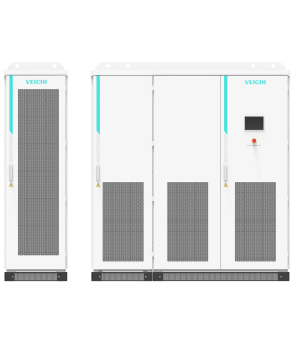
- VPS01 – 200 kW to 1000 kW across five models, 400 V output, battery window 630 V to 900 V, 2 to 12 MPPT channels. Choose it when you want the widest rating ladder and an existing high-voltage battery bank in the 630 V to 900 V band.
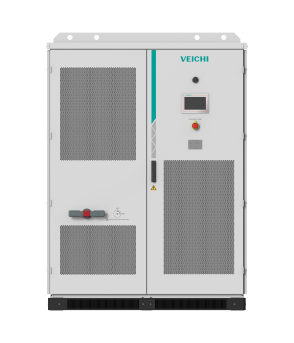
- VPS20 – 300 kW to 1000 kW across three models, all-in-one cabinet combining PCS, MPPT, DC-DC, STS and EMS, battery window 450 V to 950 V, up to 12 MPPT channels, about 26% smaller footprint than a comparable separate build. Choose it where floor space is tight, where the battery string voltage varies more widely, or where you want PV, battery and generator in one machine with one controller.
Where Micro Grid Inverters Are Used
- Factories and industrial parks – peak shaving, demand-charge control, and ride-through for processes that cannot stop.
- Islands and remote communities – replacing diesel-only generation, with PV and battery carrying the daytime load and the generator covering the rest.
- Mining, oil and gas sites – weak or absent grid, large motor starts, long feeders.
- Campus, hospital and data centre backup – where the outage cost is far higher than the equipment cost.
- PV plants with storage – curtailing less and shifting output into the evening.
Frequently Asked Questions
What size of site needs a micro grid inverter rather than a normal hybrid inverter?
Once the site is fed at three-phase 400 V from its own transformer, has a generator, or has a contractual obligation to stay live through an outage, a micro grid inverter is the right class. Below roughly 30 kW a standard hybrid inverter does the same job for less money.
Can it work without any grid connection at all?
Yes. With a battery and PV it forms its own voltage and frequency and black-starts the site. The battery must be sized to carry the load, because there is no utility to fall back on.
Can it run alongside a diesel generator?
Yes. The inverter and the generator share the load, with the generator covering deficits and the battery covering the peaks and the generator's inefficient low-load hours.
Which battery works with these inverters?
Li-Ion packs whose voltage stays inside the DC window: 630 V to 900 V for VPS01-GE0A, 450 V to 950 V for VPS20. VEICHI HV lithium batteries are specified for this range and communicate over the same protocol, so the pairing is validated rather than assembled.
Does it need a separate energy management system?
VPS20 integrates EMS in the cabinet. VPS01-GE0A dispatches PV, battery and generator on its own controller and can be supervised from the site monitoring platform for scheduling and reporting.

 Leave a Message